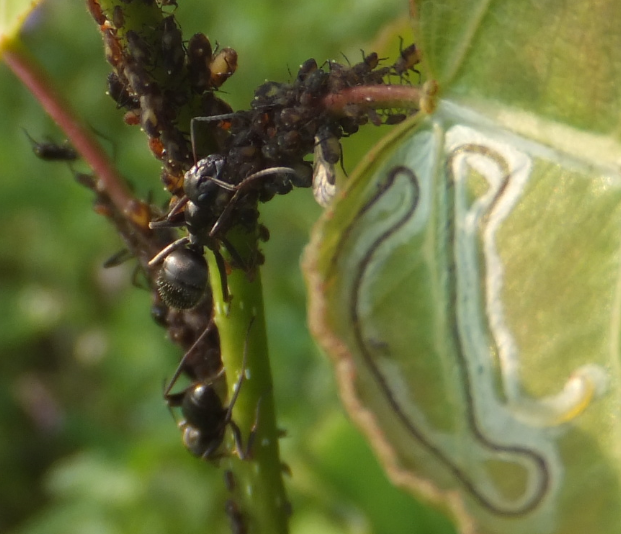
A black ant tending her flock of poplar leaf aphids as they feed on a young aspen sapling. On the leaf to the right you can also see the tracks of a common aspen leaf miner with the culprit himself at the end of the trail.
A black ant tending her flock of poplar leaf aphids as they feed on a young aspen sapling. On the leaf to the right you can also see the tracks of a common aspen leaf miner with the culprit himself at the end of the trail.

The tallest trees of the 1995 plantings are the Eastern Cottonwoods. They are now about 75 feet tall whereas the rest of the forest canopy looks to be about 40 feet high. They grow quickly and the 20 year old trees already have substantial trunks. They are, however, very short lived trees; some of them have already toppled over. The cottonwoods take their name from the fluff their seed pods produce (see above). The ground beneath the female trees can be covered in the stuff in late June.


The cottonwoods sucker but their suckers are not particularly successful, dying back either in winter or in summer droughts. Only one sucker, pictured above, in the 2009 planting area has survived for more than 3 years. When the suckers do grow, they grow very quickly and can reach over 6 feet in a single season. The large shiny triangular leaves, pictured below, are quite distinctly different from the other suckering poplar species on the berm: the smaller rounded leaves of the aspen suckers (see last picture). As can be seen in the picture, that aspen sapling is suffering from poplar leaf aphids.


