Showing posts with label trilliums. Show all posts

Wednesday, May 24, 2023

Natives and invasives


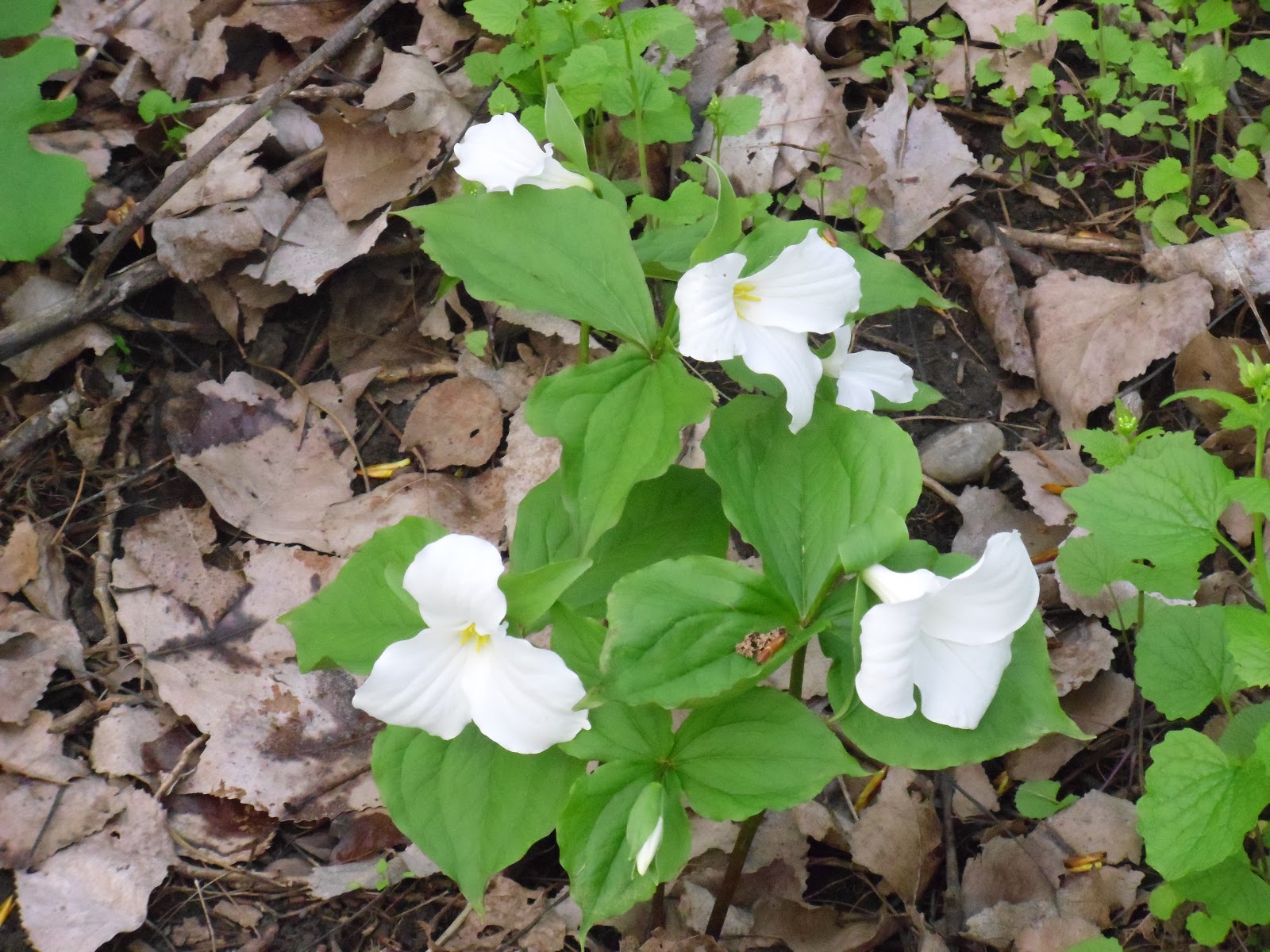
These Trilliums have been here for 13 years since they were rescued from an area in Kanata that was to be developed. There were 6 flowers this year, about the same number as I started out with but there are a bunch of plants with small leaves so maybe in a year or two if the rabbits don't take an interest there'll be more. For the past few years it seems like one gets felled each year by a rabbit that has to relearn that trilliums don't taste good. This year the rabbit ate half the flower bud from one plant, which is at least better for the plant than taking it down at the stem.

This year I removed some buckthorns from around these trilliums in order to give them a bit of light. I've recently learned that European Buckthorn is alleopathic, meaning they produce a chemical that supresses the growth and germination of other plants, so I've become much more willing to intervene and remove the buckthorn. I've noticed that buckthorns are pretty effective at suppressing grass. Where they form the edge of the forest the grass dies back from under the bushes. Other trees and bushes are not nearly so effective at keeping the grass at bay; for instance grass can happily grow under sumac.

This flower is Creeping Charlie, an invasive from Europe. I planted this patch, inadvertently, about 6 years ago when I planted a black locust in the 2009 area. In contrast to the trilliums, the creeping charlie is spreading quickly as a dense mat in the shade of the blacklocust. That part of the 2009 area still has grass although the black locust is growing quickly. I expect the creeping charlie will eventually disappear when the grass loses out to trees and bushes. Creeping Charlie seems to like growing in tall grass (there is more of it on the north side of the berm in the long grass) but I've never seen it growing in a proper forest's leaf litter.

Monday, May 25, 2020

Baltimore Orioles

A couple of Baltimore Orioles flew out of this lovely crabapple. I attempted to take a picture of them as they were hopping around in the bushes but all I got were flashes of orange in leafy green. It is interesting how you can see things much more clearly in real life than in a photo. It isn't just a matter of pixels, "seeing" is more interactive than "looking". You change your focus of attention, you use your depth perception, you move your head to parallax shift thing that are in the way, all in order to construct an image in your mind of the item that has attracted your attention.

I've been noticing these violets along my path for about a decade now. The mowers abandoned their strip around the 1995 planting area over 5 years ago, and now the sumac are starting to overgrow the path yet the violets persist. The trilliums and bloodroot I planted that are a few steps away from these violets inside the forest are still there. They have hardly expanded there presence. I think there were 6 trilliums this year, before the rabbit tax. Time moves at a more sedate pace for plants.

Sunday, May 26, 2019

10 years

It was 10 years ago this May that the first trees were planted by Manordale School kids. The first few years were quite hard on the trees. Some got smothered by the grass, some were girdled by field mice, and some just failed to thrive in their new location. Other trees arrived, either as volunteers or as new transplants. As the years have passed the survivors have established themselves and I have grown to know many of these trees as individuals. Each spring I nervously check to see who was attacked by the darned field mice over winter. I haven't noticed any girdled trees so far this year which would be a first if it holds up. Sometimes the girdling is hidden by grass until later in the summer when the drier conditions make the lack of connection to the roots much more apparent.

10 years of watching this area develop has given me an appreciation of how slowly mother nature can move. Even violets, a nuisance that spreads all over the garden and lawn at home don't spread quickly once you let Mother Nature be the gardener. The violets in the above picture have basically stuck to the same location where I first noticed them 10 years ago. The clump is a bit bigger, but they haven't spread more than a few meters. The trilliums I rescued over a decade ago are still exactly where I planted them. I understand why people are instructed to not pick the trilliums; the great glades of trilliums you can see in the woods each spring are probably the product of centuries of growth. I don't think the little patch I planted can sustain even the odd rabbit who comes by each spring to see if trilliums are tasty.

This spruce tree is one of the surviving seedlings planted by the kindergartners 10 years ago. The child is probably as tall as this sapling now.

Monday, May 14, 2018

Guerrilla Gardening and Escapees

There is a fine line between guerrilla gardening and escapees. I think this pulmonaria is probably an escapee from the neighbour's garden but I don't know how the lone daffodil below got there. Yesterday I checked out the bloodroot and trilliums I guerrilla gardened. The bloodroot is slowly establishing itself but the trilliums are not having a good year. It seems like someone (looking at you Rabbit) is eating the flower buds. There were only two trilliums in flower yesterday while I recall seeing seven flower buds earlier this spring.

The other day I was checking out a bit of raspberry that I had planted back in 2009 on the north side of the berm. It had never amounted to much as it never overcame the grass in that area, but I was surprised to notice right by the rasperry plant some yellow trout-lily leaves poking through the grass. There isn't any yellow trout-lily on the berm east of Ben-Franklin Park but these guys must have come along for the ride when I took the raspberries from a ditch south of Barrhaven.

I was attacking the patch of dog-strangling vine today, when I happened to notice a Baltimore Oriole feeding in the poplars above me. The patch of dog-strangling vine at the end of Newhaven seems to be surviving my regular attacks on it. I don't believe I have let it set seed since I noticed it a couple of years ago yet the patch is surviving just fine either from the seed bank or from growing back from the roots.

Another rare visitor to the berm I saw last week was a little raccoon. We both froze when we spotted each other and had a bit of a stare-off until he decided that I wasn't going to get out of his way and meandered off into the trees.

In flower

  • Dandelion
  • Daffodil
  • Pulmonaria
  • Bloodroot
  • Trillium
  • Violets
  • Garlic Mustard
  • Yellow Rocket

Monday, May 22, 2017

Flower Time

The trees and bushes are in flower and I went out with a new (to me) camera to try it out.

Redbud (Cercis canadensis)

Pin Cherry (Prunus pensylvanica)

In Flower

  • Redbud
  • Pin Cherry
  • Trilliums
  • Creeping charlie
  • Violets
  • Daffodils
  • Lilac
  • Honeysuckle
  • Dandelions
  • Forget-me-not
  • Elderberry
  • Common speedwell
  • Yellow archangel
  • Self-heal
  • Crabapple
  • Apple

The trilliums that were planted back in 2009 haven't expanded very much, this year there were 10 blooms.

Tuesday, June 7, 2016

Spring 2016 Updates

Invasive Honeysuckles

The Trilliums did well this spring with 11 flowers. I'm not sure I could say that any new plants have developed but the existing plants are larger and more vigorous than previous years. I visited the trilliums in Ben Franklin wood as well this spring and they are doing ok. There are more red trilliums in the woods than I remember seeing before.

There doesn't seem to be very much field mice damage to the trees this spring compared to previous years. A few trees that had been girdled the previous winter but had still leafed out last year didn't come back this spring but I don't notice any damage that I can say for sure occurred this winter.

The white pines took a hard knock on their inventory of older needles over winter. Some of them look quite sparse except for the buds growing with the current year's needles.

The patch of dog strangling vine (at the end of Newhaven) I hand removed last year has come back strong. I have already removed 200+ stalks of dog strangling vine from the patch this spring.

Most but not all ash trees on the berm have been killed by the emerald ash borer. There are a few smaller trees that haven't been attacked yet and the smaller seedlings are growing especially on the north side of the berm.

Sunday, May 10, 2015

In Bloom

It broke 30 degrees last week and suddenly everything is in bloom:

  • Crab Apple
  • Canada Plum
  • Dandelions
  • Forget-Me-Nots
  • Elderberry
  • Creeping Charlie
  • Daffodil
  • Garlic Mustard
  • Trilliums
  • Bloodroot
  • Yellow Rocket
  • Violets

Thursday, May 22, 2014

Emerald Ash Borer is here

The trilliums are just about over for another year. Above is a picture of some of the trilliums we transplanted to the 1995 tree area in 2009. This clump and the clump of bloodroot transplanted at the same time are only slowly expanding.

There is an ash tree close to the trilliums that I have suspected for a while was suffering from emerald ash borer. The winter before last I saw a hole which looked like a woodpecker had been feeding on the tree and last year it only had a sparse canopy. This year while visiting the trilliums I noticed that there are several of the D shaped holes (see below) in the trunk that Emerald Ash Borers make when they emerge as adults from the tree.

This spring the only signs of life on this tree are on the shoots coming up from the base. Presumably the emerald ash borers have completely girdled the trunk of the tree. The shoots at the base of the tree are another indication that the tree is under attack, but I probably should use the past tense as once you see the exit holes the emerald ash borers have done their work and have already left.

On the berm beside Huntclub these are the first definite signs I've seen of Emerald Ash Borer but last year the damage from the ash borers really became noticeable in this part of the city. There was a whole line of dead ash trees on Baseline and some dead trees along Woodroffe.

Thursday, May 9, 2013

and suddenly Summer

The trilliums seem to be holding their own against the garlic mustard. There are seven trilliums flowering in the patch rescued back in 2010. The hot and dry weather over the past week has compressed spring. The trees are leafing out already. The crabapples are blooming as are the wild plum back in the corner and the serviceberry. In addition to the trilliums and garlic mustard pictured above, there are dandelions, yellow rocket, forget-me-nots, violets and wild strawberry blooming.

Seven-Spotted Lady Beetle (Coccinella septempunctata)

Last year I don't think I saw one of these traditional looking lady bugs; this is the second one I spotted this year. Last year about this time I saw loads of the twelve-spotted lady bugs that aren't so hemispherical and are a paler shade of red. I haven't seen any of those yet this year.

A troop of scouts have planted a bunch of pine seedlings in the 2011 area. The place needed it as many of the evergreen trees had not survived the past two summers of drought. I'm not sure how well the new trees will do. The scouts seem to have just sliced the sod with a spade and then dropped the seedling into the groove without much thought of trying to match the soil depth or using loose soil to pack in the root ball and avoid air pockets.

Monday, April 30, 2012

Spotted Lady Beetles

It was a nice sunny afternoon and these little spotted lady beetles were out in force. According to the bug guide dandelion pollen is an important early spring food source for these beneficial insects. Their normal food is other insects. I must have come across a dispersing group that had overwintered together because in one area it seemed like every third dandelion had a beetle on it.

 In bloom:
dandelions
 foget-me-nots
 violets
 trilliums

Friday, April 29, 2011

Early Flowers

The spring wild flowers are taking their time this spring. It has been a very rainy and cool April. Here is a picture of a bloodroot and some trilliums that were rescued from the beaver pond area of Kanata last summer. The area was cut over this winter in preparation for blasting and a new housing development. It's nice to see a tiny bit of the South March Highlands survive. In the picture with the trilliums is some garlic mustard, a shade loving invasive species that also flowers in the spring time. It is widespread under the trees of the 1995 planting on the east side and in the northeast corner.


Sunday, April 25, 2010

Predators and a visit to Ben Franklin Wood

Yesterday while inspecting the West Side planting area I saw a couple of rabbits scuttle into the thicket. They must have heard something besides myself because I had been standing still at the time. Moments later another rabbit bounded past at a full gallop through the trees into the thicket. Hot on his tail there was a crash and a crack and a big red dog jumped out of the forest. He was suprised to see me as he had evidently been focused on rabbits. His master called and he bounded back into the wood having evidently forgotten about the rabbits. The dog got me thinking about the predators on the berm. Obviously the dog was a predator although he might not be too successful with rabbits. What other predators were there?

In the insect world there were loads of unidentified spiders crawling through the grass. I had also seen many 12 spotted lady bugs and one spiny soldier bug but what potential large wild predators were there? I have seen scat of a medium sized carnivores but haven't actually seen anything. It would be very exciting to see a coyote, fox, weasel, or shrew as there is evidently a plentiful supply of meadow voles around. I have no doubt that there are red tailed hawks that visit the area but I haven't actually seen them.

After inspecting how the trees are doing (everything is leafing out quickly now) I continued on to Ben Franklin park to see if the Trilliums and Dog Tooth Violets were out yet(they were). Along the way I noticed the evidence that some predator had caught a bird. By the amount of feathers and the size of feathers it was quite a large bird, perhaps a sea gull or a pidgeon. Further on, as I entered the woods I found some more evidence of a successful predator. A squirrel tail was lying on the path, either someone has a full stomach or there is a very sorry looking squirrel running around in Ben Franklin Wood.

In bloom:
dandelion
common speedwell
shepherd's purse (under oak)
yellow rocket
violet
garlic mustard
forget me not
elderberry (north corner 1995 planting)
cherry ( escapee by north corner)
crabapples (just about to start)
daffodil (escapee by north fence)