Monday, August 8, 2011

Black and Yellow Orb Web Spider


Walking through a late summer meadow one of the most common things you find are the webs of the Black and Yellow Garden Spider (Black and Yellow Argiope). These guys are pretty conspicuous. The web is a nice regular spiral design hung from tall shrubs or weeds. These big guys are easy to spot as they sit out in the middle of their web waiting for a grasshopper to get caught. The one above was about 2inches across with the thorax about as big as a large raspberry. I wouldn't want one of these guys crawling on me so I have to be careful to avoid walking through their webs.

The purple vetch is going to seed now with the goldenrod and queen anne's lace at their prime.

Monday, July 25, 2011

Nitrogen deficiency


Here is a maple where you can see that the leaves are yellowing between the veins showing it is lacking nitrogen. In the grass around the maple you can see the purple vetch a nitrogen fixing legume is doing exceedingly well. These two facts may be related. It seems like the purple vetch is doing better this year than either of the previous two years. In the previous years birdfoot trefoil seemed to be the dominant legume creating large mats but now in the square where the trefoil has been uncut for the third year now, the trefoil is losing out to the vetch. On the westside where this is only the second year without mowing the treefoil is still going strong.

Here is a link discussing the use of trefoil as a pasture crop. One thing they note is that while it is a perennial it needs to self seed if it is to become permanently established. I think we might have a situation where the trefoil needs a more disturbed and open location to get established than the vetch and that when young can't compete in the long term with the faster growing grasses and the weeds.

Monarch


I was thrilled to see this monarch flitting about yesterday. I think they are so beautiful and know that their numbers are declining. This is the first I have seen this summer. I saw him in the long grass on the north side of the berm.

Japanese Beetle


A group of Japanese Beetles on a Glossy Buckthorn. Both the plant and the insects are invasive species. The Japanese Beetles are a large slow beetle that like to hang out in groups on the top of leaves. They spend their grub stage in lawns eating grass roots but here you see them too busy mating to care about predators. They must not taste very good to birds as they are easily spotted with their shiny armour and their habit of hanging out on the top of a leaf in broad daylight munching away. Here you see the lace like evidence of them eating the leaves of the bush. They are a bit of a generalist in what they eat but I have noticed them to be fond of raspberries.

Thursday, June 30, 2011

Common Ringlet


Here is a common butterfly found in early June flying around the square. They are a small brown nondescript butterfly commonly found in long grass in sunny areas. They are also called the Large Heath.

In Bloom:
St. Johns Wort
Purple vetch
daisy
stitchwort
white clover
purple clover
trefoil
buttercup
yarrow
wild carrot

Thursday, June 9, 2011

Where there is life there is a chance

This spring the trees planted close to the road on the West Side had a really hard winter. In the front row were 4 maples and a fir tree. In the second row was a sumac, a hazel, a fir tree and two maples. Further back there was a couple of hackberries, a sumac, a linden and a gap where a couple of spruce trees had been that failed to successfully recover from the transplantation and where a couple of maples were cut down by some animal last summer.

In early May, only one of the maples in the front row looked alive. Three other small maples looked like they had been girdled by rodents. The fir tree in the front row looked healthy but there was no sign of bud growth. In the second row only the fir tree and one of the maples looked alive. Further back the linden and the sumac had a couple of buds each but the hackberries had not yet shown signs of life. On May 7th we planted a hackberry and an alder up front to replace the missing maples. At the time only 6 of the 14 named trees in the first four rows of the West Side showed signs of life.

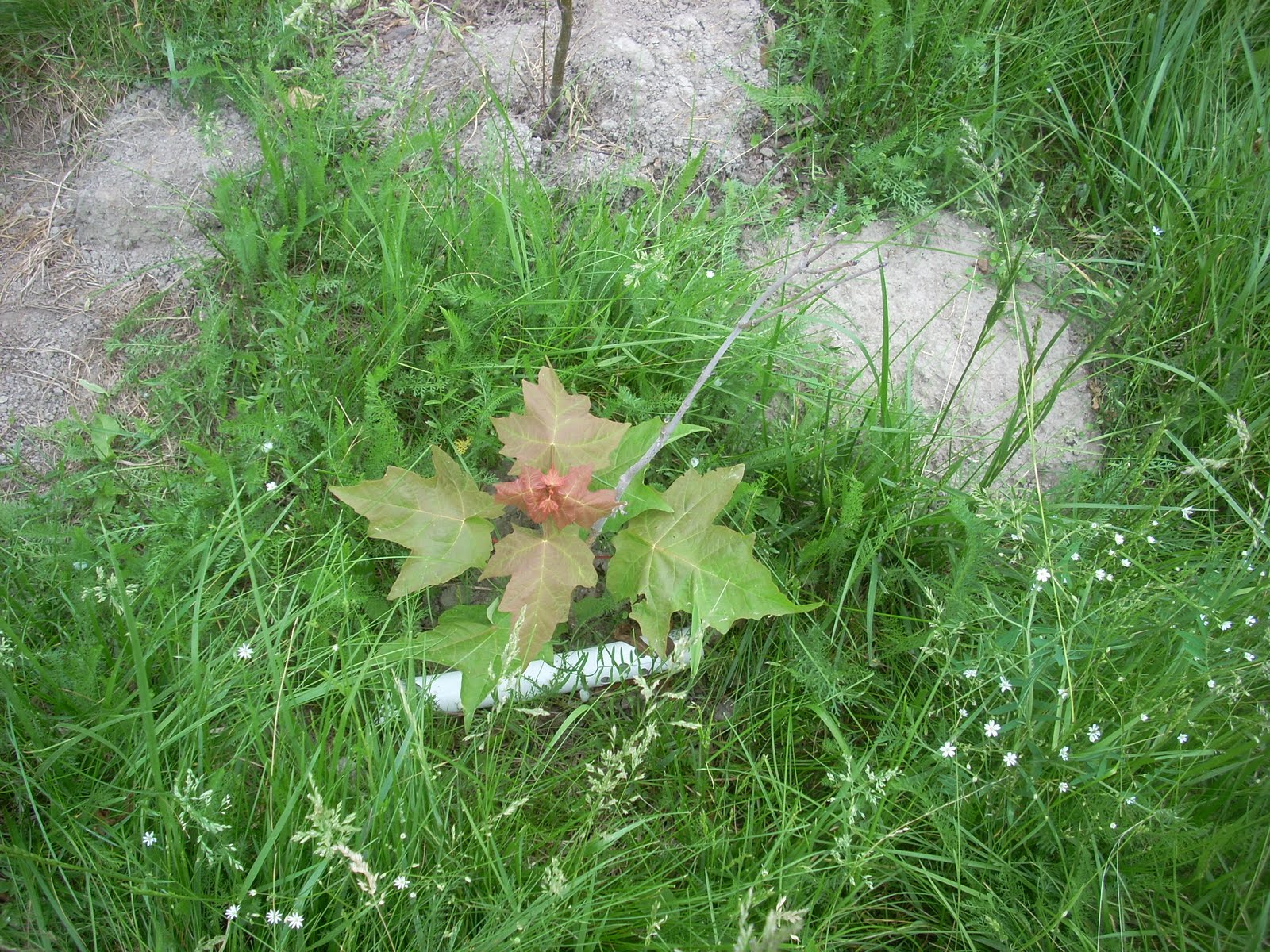
One maple in the second row in particular was particularly worrisome. It had no rodent damage and it looked like it should have viable buds but there was no growth. Eventually on the 23rd of May I decided to take off the wrap around the trunk that protects it from rodents. Suprisingly there were tiny leaves growing on the trunk( first picture). A few days later I finally saw the fir tree in the front row showing green growth on the buds and noticed that a couple of the maples in the front row were regrowing from the roots (second picture is one of them from today).

Eventually the lindens started growing too. One of them in particular only showed green growth in June, again, only after I took the wrap off the trunk and found growth close to the base of the tree. As of today 11 of the 14 named trees are growing. One maple in the front row never recovered from the rodent damage, the hazel failed and one of the sumacs failed. The hazel is unsuprising as many of the hazels died or had severe die back over winter. However the sumac is the only instance I know of where a sumac died over winter. It demonstrates how difficult a location it is for trees. You can also see in neighbouring areas of the 1995 planting that the trees in the front directly exposed to the road are having a hard time surviving. You wouldn`t think that a road 25m away would have that large an impact on a tree but it dooes seem to be the case.

Friday, June 3, 2011

A Blinded Sphinx Moth


Noticed this guy hanging on the side of a branch of the large oak tree the other day. It was so well camouflaged I thought it was a bit of bark initially. He was a very large moth, and would be more than a mouthful for any bat. When I got back home I found him on the net as a Blinded Sphinx. What a great name for a moth. According to the article they like oak and popular trees so he should have been right at home on the berm.