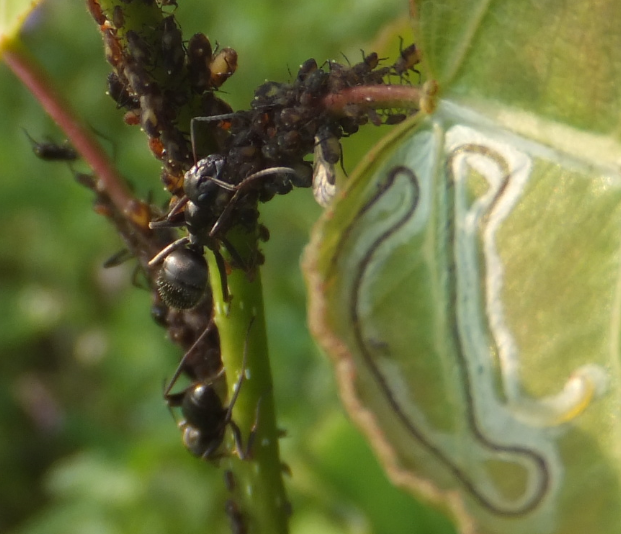
A black ant tending her flock of poplar leaf aphids as they feed on a young aspen sapling. On the leaf to the right you can also see the tracks of a common aspen leaf miner with the culprit himself at the end of the trail.
A black ant tending her flock of poplar leaf aphids as they feed on a young aspen sapling. On the leaf to the right you can also see the tracks of a common aspen leaf miner with the culprit himself at the end of the trail.

The tallest trees of the 1995 plantings are the Eastern Cottonwoods. They are now about 75 feet tall whereas the rest of the forest canopy looks to be about 40 feet high. They grow quickly and the 20 year old trees already have substantial trunks. They are, however, very short lived trees; some of them have already toppled over. The cottonwoods take their name from the fluff their seed pods produce (see above). The ground beneath the female trees can be covered in the stuff in late June.


The cottonwoods sucker but their suckers are not particularly successful, dying back either in winter or in summer droughts. Only one sucker, pictured above, in the 2009 planting area has survived for more than 3 years. When the suckers do grow, they grow very quickly and can reach over 6 feet in a single season. The large shiny triangular leaves, pictured below, are quite distinctly different from the other suckering poplar species on the berm: the smaller rounded leaves of the aspen suckers (see last picture). As can be seen in the picture, that aspen sapling is suffering from poplar leaf aphids.


Creeping charlie, burdock and field horsetail.
There is a fairly large colony of field horsetail growing on the north east side of the berm adjacent to the backyards of Kimdale. The mower hasn't been able to reach this steep shady slope for the past four or five years and other plants have taken the opportunity to expand and diversify the plant community of this grassy slope. Field horsetail is dead common but I have never learned the name for it until now. That is what this blog is for: to encourage me to extend my knowledge of the common plants and animals around me.
Last Monday a day long rain broke what was turning into a bit of a dry spell with the temperature rising to the high 20s for about a week. The new growth of sumac by the road was wilting from the lack of rain. The next evening it was very warm and humid when I visited the berm after dusk. The bats and fireflies came out, as did the mosquitoes. We had another good rain on Saturday and the temperatures are now considerably cooler.

After 6 years some of the trees are outgrowing the spiral tree protectors. I took some of the spiral protectors off last fall from the largest trees and most of the rest from the 2009 trees this spring. Unfortunately, as a result, one of the last remaining sugar maple saplings was completely girdled by the field mice over winter. But if I don't take them off I am worried that the trees will be choked by the tree protectors themselves. On some of the trees, as in the picture above, the plastic spirals were starting to constrict the growth of the trunk.
Sometimes the tree protectors fail to fully protect the trunk yet the tree is lucky because of some small factor like the stick in the picture below protecting a portion of the trunk, other times they are lucky one year but not the next. Sometimes they will come back and sprout up from below where they were girdled. In that situation the new bark of the sprouts is very attractive to the field mice the next winter. Occasionally the tree is super lucky and the field mice spare one or two just because they can't reach all sides of the sprout.
In the end I'm not sure there is much that can be done for some species of trees except not plant them in a location that is attractive to meadow voles (field mice). It occurred to me today that one might have more success planting sugar maples in a raspberry bush than in an old field.


It broke 30 degrees last week and suddenly everything is in bloom:


