Showing posts with label maple. Show all posts

Thursday, November 16, 2023

An Owl

It was a lovely day today to visit the roadside berm. I spent some time clearing out the european buckthorn bushes that form a barrier between the 2009 area and the older forest. It is really easy to recognize the buckthorns at this time of year as they are the only deciduous bushes with grean leaves still hanging on. On my way home I was surprised by this owl just hanging out a few feet from me.

The 2009 replanting area is now starting to resemble a forest. Some of the maple trees are starting to gain some character, like the one below that is starting to push up the earth as the root flare grows. The forest floor of the 2009 area is losing its grass and some seedlings are starting to establish themselves. Below is the first pine seedling I've noticed growing in the area.

As I was walking along, looking at the forest floor, I found one odd bit of trash. I wonder if it was a eurpoean or african swallow that dropped this.

Sunday, April 16, 2023

Tuesday, May 19, 2020

Spring Stirrings 2020

Pink Spotted Lady Bug Coleomegilla maculata

These pink spotted lady bugs over-winter as adults in large groups and can often be found stirring from their slumber location in the early spring sun. I came across a bunch of them earlier this spring at the base of the large oak tree. A couple of days ago I think I came upon the same group but this time they were chowing down on dandelion pollen. Practically every dandelion close to the oak tree had a pink lady bug on it.

I've met this cute baby bunny a few times this past week. He has been hanging out by the large poplar cut down by the hydro people. The logs provide convenient hidey-holes for him. The logs also provide convenient places to sit.

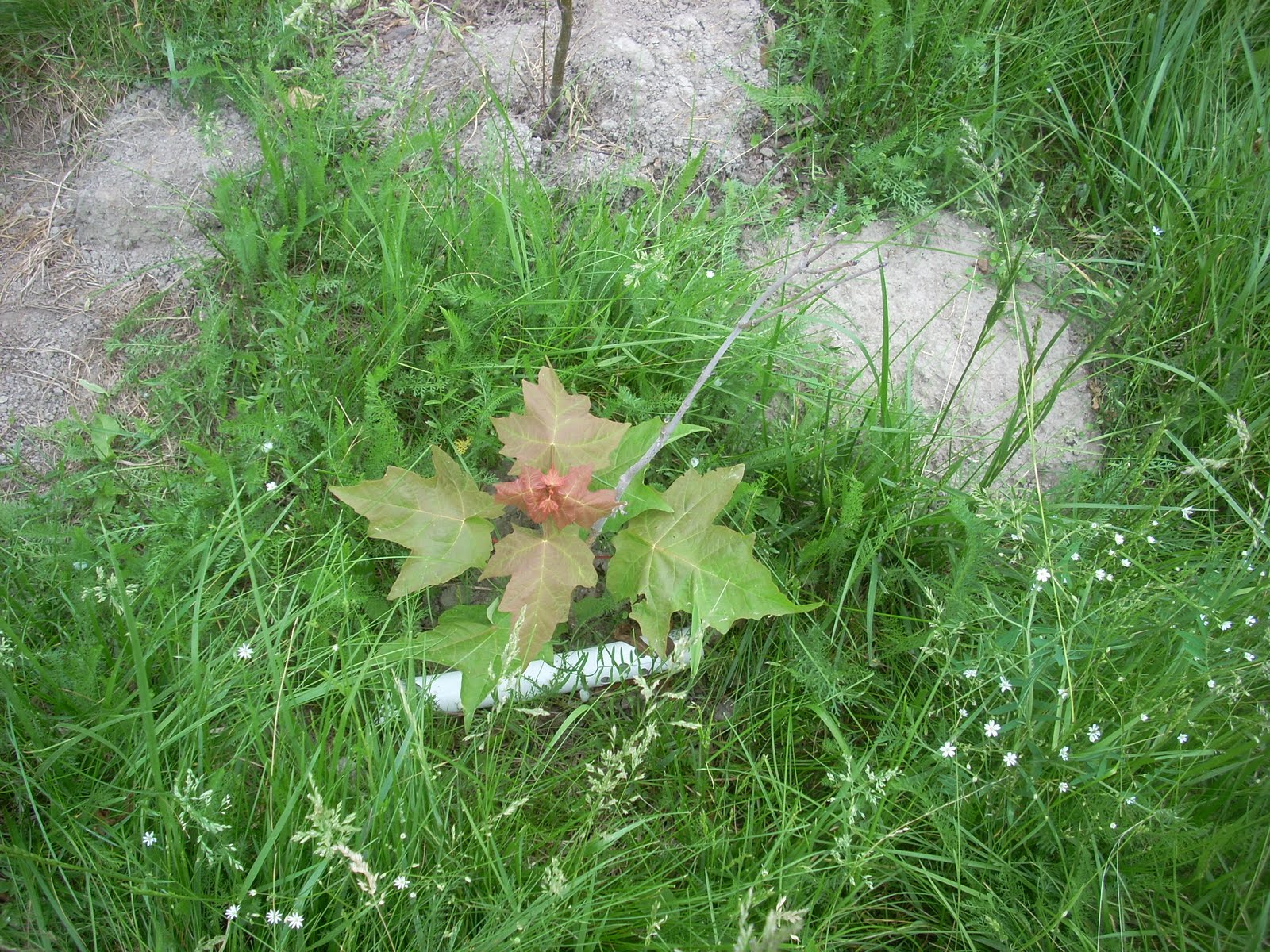
I've planted 5 sugar maples seedlings, 2 baby spruce and a small cedar this spring. I've also done a fair bit of clearing of poplar suckers to give more light to the slower growing maple trees.

Monday, October 30, 2017

Milkweed Tussock Moths

Milkweed Tussock Moth

This story begins by my house earlier this summer when I noticed a bunch of tiny fuzy caterpillars munching away on the leaves of a milkweed growing under the lilac. Every once in a while I checked how they were doing and eventually they completely consumed the first plant and started on its neighbour. By then they were big enough to be identifiable as Milkweed Tussock Moth caterpillars and I started worrying that they were going to consume the entire milkweed patch. One day in late August I noticed there were only three left on the last leaf of the milkweed patch. I decided to make an intervention and took the three out to the roadside berm area where I new there was another milkweed patch. The next day I noticed a couple more caterpillars wandering around looking for food so I decided to take them over to their brothers on the berm. To my horror when I got to the milkweed patch one of their brothers that I had left there the day before was being consumed by three shield bugs and more shield bugs were on the prowl around the milkweed. I couldn't leave my new charges there so I was the new not-so-willing owner of two Milkweed Tussock caterpillars. I stuffed fresh milkweed leaves in the box and in a few hours the pair had consumed half a leaf. Over the next few days I stuffed fresh leaves in to be turned into caterpillar poop but eventually noticed the new leaves weren't being touched so I checked for my charges and found one had already formed a fuzy little cocoon. I took the contents of the box and left it where the milkweed patch was under the lilac in hopes that maybe a moth or two will emerge next spring.

I had never noticed these caterpillars before and had previously always assumed that only Monarch caterpillars ate milkweed leaves. I don't think I've ever spotted a Monarch caterpillar on a milkweed but I keep on looking in hopes of spotting one one day. This was a relatively good year for monarch butterflies I think. I saw way more this year than I had in the previous two years. This might have been a good year for Milkweed Tussock Moths as well, as I've spotted a couple more caterpillars on different milkweed patches along the berm.

Last Thursday I visited the berm and noticed that the milkweed pods were opened and spreading their seeds in the wind. I never noticed before what time of year the pods opened.

Friday, October 25, 2013

Fall 2013

Five summers after being planted, the trees have grown. Many of them have outgrown their white plastic trunk protectors. I've taken quite a few off that were tight and we'll see how the trees do without them. Below is an image of the trunk of one maple tree that got attacked by the field mice last winter. The ant is crossing the new growth that has partially filled in the wound. The tree had a plastic trunk protector on but it didn't stop the rodent. I'm going on the theory that at a certain point, the bark gets so thick that rodents no longer find the older trees very tasty. When the spirals are removed though, the trunk that was protected looks younger than the parts of the trunk that had been exposed to the weather so I am a bit worried that the field mice will attack the trees that have been newly uncovered.


Cornfield ant (Lasius neoniger?)

Thursday, May 30, 2013

Squirrel eating maple keys

The silver maples in the 95 planting area are producing a heavy crop of seeds. This black squirrel was very busy gorging on the silver maple keys.

Wednesday, February 27, 2013

The abrupt end of one meadow vole.

More snow today. We have had quite a lot of snow this winter which makes a change from the last two winters. One unfortunate side effect of deep snow is that the white plastic spirals that protect the trees from the meadow voles aren't as effective. In the below photo you can see a meadow vole has almost completely girdled a maple tree just above where the plastic spiral stopped. A warm spell in January had given a hard crust to the snow, then a later snowfall gave the voles something to tunnel through at this new surface. This photograph was taken at the end of January when another warm spell revealed their pathways. Some of them were only market out by the dirt from their feces. In the photo below the dark specks of dirt on the snow around the trunk are feces from the meadow vole.

meadow vole damage on maple

Not too far from this tree I spotted tracks that told a very clear story in my mind. In the first photo below you can see the tracks of a meadow vole as it was hopping over a fresh sprinkling of snow past a few grass stalks poking out of the snow. Suddenly its tracks stop at a place where there are a whole mess of confusing tracks. Looking more carefully in the second photo below there are a few specks of bright red. Somebody caught the poor guy and whoever caught it must have flown there. You can see what are clearly the mark of the bird's broad tail and the marks of its feet. About 10 feet from this spot in the third photograph are the marks of a large bird's tail as it brushed the snow. The story that comes to me is of a meadow vole scampering along in the dark over the fresh fallen snow when an owl perched 50m away in the bushes spots it. It launches itself and glides in low over the snow. It caught the vole before the little guy even knew it was there and dispatched him on the spot before taking off to feed at a more secure location. I would bet the bird was an owl as a vole is quite unlikely to be out in the open like that except at night, the most likely candidate being a Barred Owl as I know they are about because I saw one this winter in the Stoney Swamp.

tracks of field mouse
meadow vole caught by owl
track of owl's tail

As a bonus, here is a Youtube video of a meadow vole behaving quite strangely in broad daylight. This isn't my video but I saw a meadow vole behave like this several years ago on the berm. It just rested in broad daylight on top of the snow as I passed quite close by on my skis. I didn't have my camera with me that day or else I would have had plenty of opportunity to get a good closeup of the fellow.

Saturday, September 29, 2012

Green Darner

Common Green Darner (Anax junius)

I spotted this guy sunning himself yesterday. What a nondescript name for such a colourful fellow.

Saturday, August 18, 2012

Annual Cicada

Annual Cicada(Genus Tibicen)


I've been listening to these guys make their loud electical buzzing sound for a while now. There has been at least one up in a tree somewhere in the backyard for the past few days. The one in the picture above is the first one I've spotted in the flesh. They're huge! At first I thought he was a dried up leaf. He was hanging on to a dried up maple tree in the 2011 planting area.

The 2011 planting area was hit hard by the drought in July. The drought is now over as it has cooled off and we have had rain on and off for the past week but the month long heat wave had already killed off many of the trees that had been attempting to comeback from last year. Some trees survived the drought better than others. The white pines were the most successful conifers. The hackberry, basswood, serviceberry and redbud did quite well, as did the suckering poplars. The maples and oaks in particular seemed to take the drought hard this year. This is the second difficult year for these trees and I'm not sure if they have enough viable buds to make another comeback next year. Maybe some of them will regenerate from the roots.

Thursday, June 9, 2011

Where there is life there is a chance

This spring the trees planted close to the road on the West Side had a really hard winter. In the front row were 4 maples and a fir tree. In the second row was a sumac, a hazel, a fir tree and two maples. Further back there was a couple of hackberries, a sumac, a linden and a gap where a couple of spruce trees had been that failed to successfully recover from the transplantation and where a couple of maples were cut down by some animal last summer.

In early May, only one of the maples in the front row looked alive. Three other small maples looked like they had been girdled by rodents. The fir tree in the front row looked healthy but there was no sign of bud growth. In the second row only the fir tree and one of the maples looked alive. Further back the linden and the sumac had a couple of buds each but the hackberries had not yet shown signs of life. On May 7th we planted a hackberry and an alder up front to replace the missing maples. At the time only 6 of the 14 named trees in the first four rows of the West Side showed signs of life.

One maple in the second row in particular was particularly worrisome. It had no rodent damage and it looked like it should have viable buds but there was no growth. Eventually on the 23rd of May I decided to take off the wrap around the trunk that protects it from rodents. Suprisingly there were tiny leaves growing on the trunk( first picture). A few days later I finally saw the fir tree in the front row showing green growth on the buds and noticed that a couple of the maples in the front row were regrowing from the roots (second picture is one of them from today).

Eventually the lindens started growing too. One of them in particular only showed green growth in June, again, only after I took the wrap off the trunk and found growth close to the base of the tree. As of today 11 of the 14 named trees are growing. One maple in the front row never recovered from the rodent damage, the hazel failed and one of the sumacs failed. The hazel is unsuprising as many of the hazels died or had severe die back over winter. However the sumac is the only instance I know of where a sumac died over winter. It demonstrates how difficult a location it is for trees. You can also see in neighbouring areas of the 1995 planting that the trees in the front directly exposed to the road are having a hard time surviving. You wouldn`t think that a road 25m away would have that large an impact on a tree but it dooes seem to be the case.


Thursday, May 20, 2010

Summer is here

Summer is here with some really hot days. It was supposed to get up to 30C today. There hasn't been a proper rain since the weekend the trees were planted. Today and yesterday the city worker came by and watered the new trees. The trees desperately needed it since they hadn't had time to spread out their roots. Some of the maple trees that had frost damage are starting to recover and are producing new leaves. A few of the pine trees that were planted don't look like they have any life in them. I suspect they may not live.

This heat is bringing out the flowers. On the south side of the berm where the grass was commonly mown and where it is a bit drier the speedwell is all over the place in the short grass. Speedwell seems to be past the prime of its bloom period. Chickweed another small white flower that does well in short grass areas is starting to become more common. On the north side of the berm the common low flower is the purple creeping charlie. It is spread out all over and it doesn't seem to be bothered by competition with tall grass as it is all through the area where the tall grass is growing. It is really quite pretty.

One interesting looking plant that has been a mystery all spring finally reaveled itself to be the devil's paint brush. it grows in several large clumps in a sunny dry area on the south side of the trees where the mower goes once a year. They have been large mats of individual small plants. Until now the plants have stayed low to the ground and have just put out some very hairy leaves from a central base. With the hot weather a flowering head has jumped up and opened up to reveal the bright orange head of a devil's paint brush hawkweed.

In Bloom:
dandelion (going to seed)
speedwell,
creeping charlie,
chickweed
devil's paint brush
fleabane, (pink just coming on)
forget-me-not
blue eyed grass ( one location)
yellow rocket
garlic mustard (past prime)

Thursday, April 29, 2010

Preparation for new planting

As part of the preparation for the new planting on May 8th I spent some time tagging the small trees with bright orange tape so that people can see them more easily.

I took a bit of an inventory of the trees and shrubs that survived from last year. I may have missed a few or double counted a few but by my count the survivors are as follows:

- 3 Pagoda Dogwood (had a lot of die back)
- 11 Red Osier dogwood
- 8 Speckled Alder (vigorous)
- 3 american elderberry
- 12 staghorn sumac
- 3 chokeberry
- 4 unidentifiable bushes
- 32 Red Maple (stubby red bud)
- 26 Sugar Maple (long narrow greenish brown bud)
- 14 tamarack (deciduous conifer)
- 6 white spruce
- 12 trembling aspen
- 5 white pine
- 3 colorado spruce
- 4 white cedar
- 2 hazelnut
- 2 basswood (tentative id )
- 8 oak (red oak? the oaks were a favorite of the voles)
- 2 black spruce (tentative identification, these did not survive transplanting well as several others went brown last summer)
- 15 bushes tentatively identified as service berries
- 5 unknown trees/bushes of very slender fragile twigs with pale drooping leaves. Buds are very slow to develop and more of the ~20 that were planted may have life in them yet. (Very tentatively identified as hackberry)
- 9 unidentified trees (most small twigs with buds only slowly developing)
- 47 white spruce seedlings

A total of 232 trees and bushes survived the first year. We were supposed to have planted 350 last year so about 66% survived. Some trees didn't show any signs of life after being transplanted. They may not have survived the previous winter or may not have been able to handle the shock of transplantation. More than a few bare twigs were planted that never developed a viable bud. A few only had one or two buds that developed. A few of the spruce trees turned brown over summer. A few of the aspens lost all of their leaves mid-summer. Some of the seedlings didn't survive transplantation and some got covered up by the summer grass. Some were chopped down by the mower last summer. The major culprit, however, was winter and rodent damage. At least half of the oaks that were planted did not survive the winter. The service berries received a lot of damage as did the sugar maples, the sumac and the hackberries. Some of the bushes were munched right down to their base and are unidentifiable. Some of the trees lost all of their roots to the rodents and toppled over. Some of the trees that are still alive are not likely to survive the summer because the rodent damage is so extensive around their base. But where there is life there is hope.

On Monday evening at dusk while I was taking inventory of the surviving bushes I noticed several bats swooping around over the 2009 planting taking insects on the wing. It is good to see bats as I don't often see them around Manordale.

In flower:
dandelion
common speedwell
garlic mustard
violets
forget-me-nots
yellow rocket
creeping charlie
serviceberry
crabapple
elderberry
canada plum (? back north corner)

Saturday, April 17, 2010

New tree planting areas staked out

It was a rainy day today when I went out to visit the trees. I saw three or four juncos hanging out by the path over the berm on the east side. The buds on the trees are starting to leaf out on a variety of early trees. The speckled alders are quite advanced and I saw my first maple leaves of spring on a sapling.

This past tuesday Jennifer the city forrester came by and staked out where the new planting for this year will be. Manordale school is getting organized to plant on Saturday May 8th an additional 450 trees and bushes in several locations along the berm.


Areas to be planted this year. The Square and the North Slope were planted in 2009 and the new trees will fill in gaps. The West Side and the Bush Area will be new plantings for this year.